Learning Live 2026: grappling with the AI and human challenge
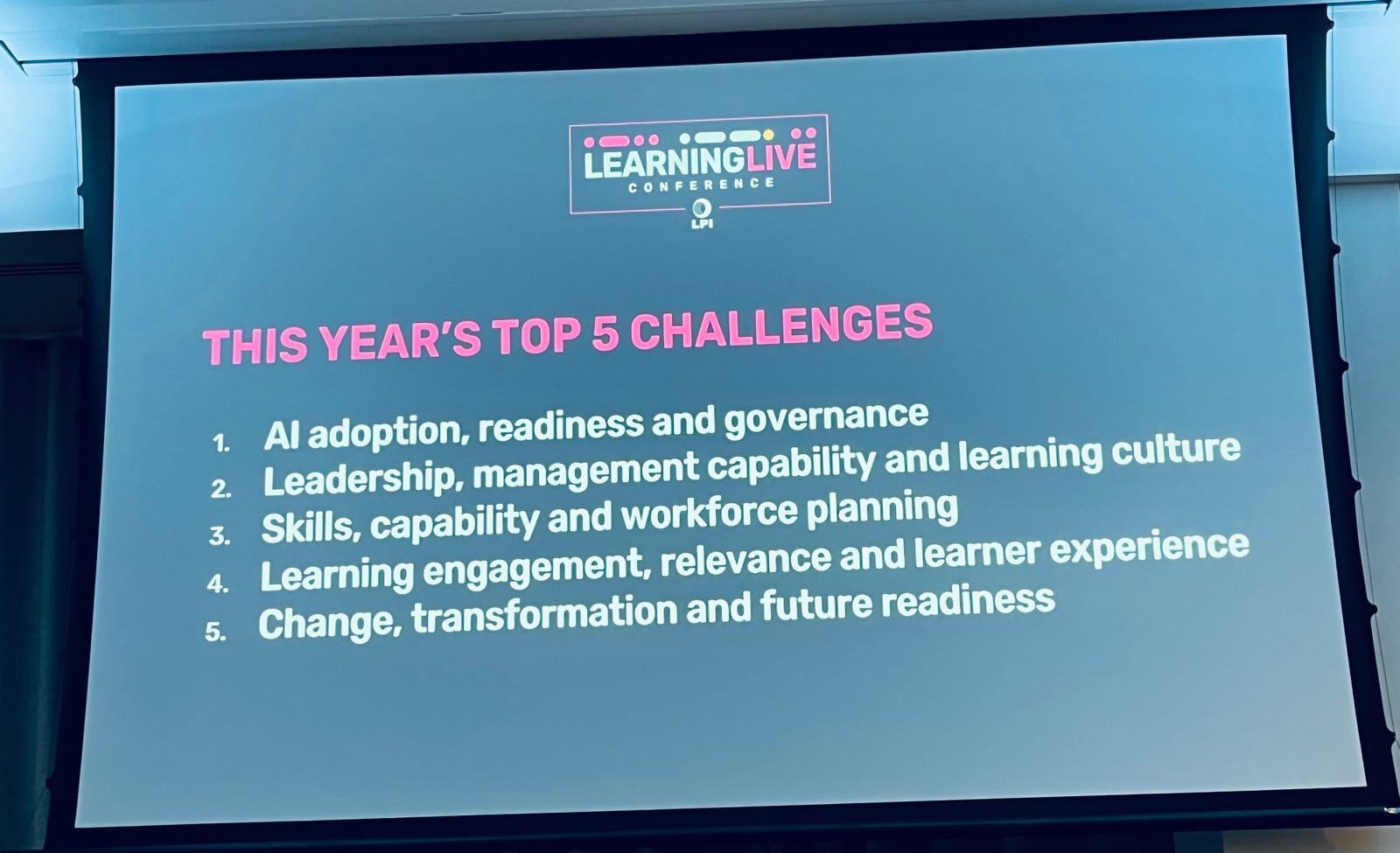
L&D leaders know what they have to do. They know the challenges and those challenges shaped the agenda for the The LPI (Learning and Performance Institute)‘s Learning Live 2026.
But HOW should L&D tackle what it knows it needs to do? In some senses this is what Learning Live was all about. In his opening address, LPI CEO Ed Monk encouraged delegates to challenge each other, to challenge thinking.
These are uncertain times and I felt that at this year’s conference. L&D is under pressure on many fronts – just look at those 5 challenges . . .
But it is AI that is dominating the conversation. L&D teams are spending more time thinking about it, being asked to support the organisation around it and looking at how L&D should transform itself using AI tools.
And all the while, there are significant human challenges for L&D to attend to.
None of this is helped by the AI hype in the industry. It’s on every conference agenda, influencers and experts have sprung up everywhere – there is no shortage of people telling L&D what it should do. And there is a momentum around it – I attended a session on agentic and there was no sense of whether this was the right approach or what the implications might be for jobs. It seems agentic is a done deal.
It was interesting to hear from workflow automation company ServiceNow about how its learning function is adapting with AI. Its approach is to look at the work first, identify what AI can do and then redesign roles and skills around that. Then it decides what supporting tools and technologies are needed.
The L&D team runs a hub and spoke model with data, standards and technology at the centre and learning design and delivery pushed out locally. Data is key here and the company collects what it calls a ‘talent signature’ of 200 pieces of data on each employee. This is the oil in the engine for personalised learning and talent mobility in the organisation.
At NatWest, AI innovation starts with leaders. KimberlyRodrigues, learning strategy and impact lead at NatWest, says the company has focused on helping leaders become more confident with AI and more able to discuss where and how AI can support the business. The company started with leaders as it sees them as multipliers for behaviour change and advocates for adoption and responsible experimentation.
“I think that’s a key thing. Leaders being in a position where they’ve got the confidence to identify where technology can help them with a business problem, as opposed to thinking, what can I do with this technology?”, she says.
Helping leaders navigate uncertainty was a key theme of leadership coach and organisational transformation expert Daniella Freeman‘s talk.
She says that for complex challenges, leaders need to test and learn. “Complex is where you have to probe, sense, respond, and have human intuition.” And this, she says, will require leaders to approach these challenges without assuming they know the answers.
“You cannot go in knowing the answers, so you have to go in from a place of curiosity,” she says.
Freeman echoed other speakers saying that skills are changing quickly and the skills we need now might be very different to the ones we need in a year’s time. That’s going to be an upskilling challenge.
So, yet more uncertainty as a result of AI.
What are learning leaders to make of all this? I asked Avinash Chandarana, FLPI, chief learning and transformation officer at MCI Group, for his take on where L&D is with AI and what this means for the human side of work.
His view is that L&D has been focused on the tools more than strategy and that now needs to change.
“Just a couple of years ago AI was all about the tools – how you integrate AI in L&D, for example. Can it make us do things faster? Can it create content faster? And I think there was a race towards integration of AI tools and LLMs in business. But without understanding what it means in terms of the change process and the conditions you need for success,” he says
MCI Group has shifted to looking at what AI now means more broadly for the business. “We’ve gone beyond the tools and are looking at that bigger picture. What about the change you need in the conditions? What about the change you need in organisational design for the human AI organisation in the next two to three years? What value are we now bringing to the business by using AI for the last three years? This is surfacing new areas of focus.”
Chandarana says L&D leaders need to focus on the human experience too.
“When it comes to the human piece, we’re all feeling the pressure of the speed of change, and everyone’s panicking. AI is taking over everything. It’s becoming a zero-sum game because your clients are using AI, internal teams are using AI, interviews are being used with AI and an interviewee is using AI to answer back. So where’s the human side of it now? What value are we bringing as humans? I think that’s where we’re feeling that shift in our business, for sure.”
AI is not the be-all and end-all solution, says Chandarana. L&D leaders need to understand their value and how what they are doing is impacting on the business and how AI is helping them do that.
“We are reflecting on the whole value and the skill set of AI. What do we need to do more of, or differently? Not more of, differently.”