Research Digested: From AI to ROI: Who owns the problem?, Kaplan
About the research
Kaplan commissioned Censuswide to survey 1,000 UK employees, 600 C-suite leaders and 600 HR and L&D decision-makers in July 2026. All three samples were from organisations using AI with 50+ employees.
Key findings
- Over the last 12 months, C-suite leaders say that, as a result of AI skills gaps, they have lost a competitive bid or client opportunity (39%), found AI tools underutilisied (38%), failed to achieve expected ROI from AI (37%) and had difficulty retaining staff with AI capabilities (32%)
- 80% of employees say they are confident using AI tools productively, and 78% responsibly
- HR and L&D leaders estimate on average 37% of employees expected to work with AI tools are “genuinely proficient” – C-suite leaders estimate 46%
- 45% of HR and L&D leaders say AI tools are underutilised by the teams expected to use them. 33% of employees report being asked to work with AI without receiving sufficient training
- Who owns AI capability in the organisation? C-suite leaders say IT/technology (44%), HR (11%), L&D (6%), C-suite (28%). It’s a different picture for HR and L&D, who say that AI capability is owned by IT/technology (23%), HR (26%), L&D (18%) and C-suite (17%)
- 74% of C-suite leaders rate AI as a high or top priority, compared with 39% of HR and L&D leaders
- 94% of HR and L&D leaders say they understand the workforce capability needed for their AI strategy but 36% lack “either the authority or budget to act fully” on that
- 54% of C-suite leaders say AI investment in the last 12 months focused more on technology than workforce capability, with only 20% saying greater emphasis has been placed on employees’ skills
- 81% of employees trained in the past 12 months describe the training as effective. Among HR and L&D leaders who provided AI skills training, 63% report measurable improvements and 87% “have formally evaluated its impact”. However, 35% of employees say structured AI training reached “a significant proportion of the workforce”, the rest saying training has been informal and for small numbers of people
- Structured apprenticeship and qualification programmes are rated most effective by 31% of C-suite leaders and 20% of HR and L&D leaders whose organisation has built AI capability in the past 12 months. However, 50% of employees say on-the-job learning is the most effective way to build AI skills
- 93% of employees would value access to accredited AI qualifications or development programmes; 77% of C-suite leaders believe formal accreditation is important.
What to act on
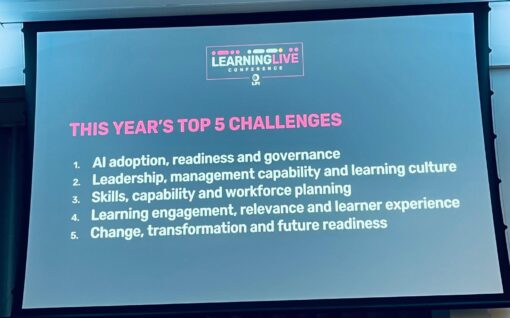
This research reveals the big differences in perspective on what is becoming a strategic priority for organisations – AI skills. The C-suite seems to have quite a different view of AI capability versus HR and L&D, the people in the organisation who should know.
The biggest red flag is that 74% of C-suite leaders rate AI as a high or top priority, compared with 39% of HR and L&D leaders. Senior leaders do not have a common view on AI and without that it is hard to see how an organisation will successfully adopt this technology.
The best method for learning AI skills is also unclear – employees want on the job support while leaders think structured training is best.
There are so many paradoxes here which show the size of the challenge in harnessing the potential of generative AI. This report should be a wake-up call for all organisations to get the leadership team and build a consensus around its AI strategy.
Read the report https://kaplan.co.uk/resources/ai-to-roi