Research digested: Into the unknown (L&D Global Sentiment Survey 2026), Donald Taylor
About this research
This survey, carried out between 17 November 2025 to 31 January 2026, received 3,797 respondents from 105 countries. The survey poses one question: “What will be hot in workplace L&D in 2026?” Respondents could choose up to three options from 15 options plus “Other”; 95% chose three. There were also optional free-text questions on biggest challenge (95% answered) and what respondents are doing now (95% answered).
Key findings
AI remains dominant but interest has peaked
Artificial intelligence received 22.5% of votes in 2026, down 0.1 percentage points from last year. This is the first time in three years that AI’s share has not increased. The report argues that fascination with AI has “probably peaked” – it remains dominant, but is no longer accelerating.
Reskilling and personalization continue to rise
Reskilling/upskilling placed second with 10.5% (+0.5) and personalization/adaptive delivery ranked third with 8.7% (+0.5). Personalisation is the only option besides AI to have risen consistently over the past four years.
The report interprets this as L&D focusing AI on tailoring content rather than on broader analytics.
Showing value is under renewed pressure
Showing value rose to 6.9%, its highest-ever share, moving from #7 to #5. The report links this rise to the pressure on L&D to justify its existence, particularly amid budget constraints and AI disruption.
Learning analytics drops sharply
Learning analytics fell to 5.7%, a decline of 1.2 percentage points – the largest drop in the table. The report questions whether L&D is underusing AI’s potential for organisation-wide analytics, instead focusing on content-level personalisation.
AI disruption has moved into a “New World” phase
In 2024, AI topped the survey with an “unprecedented” 21.5% during what the report calls the “AI shock”. In 2026, voting patterns across countries are described as “unprecedented, erratic” and no longer predictable. The report characterises this as a third phase – after “AI shock” and “AI recovery” — where old norms have broken down but new ones have not yet stabilised.
AI adoption is both action and anxiety
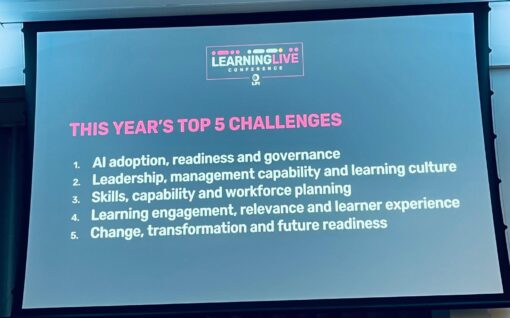
Five key challenge categories were identified through the open text responses:
-
AI adoption and integration
-
Demonstrating value and impact
-
Budget and resource constraints
-
Learning engagement and application
-
Change, uncertainty and L&D’s new role (p.15)
AI is described as both “the most visible opportunity and one of the greatest sources of anxiety”.
Pressure on L&D professionals is rising
The incidence of the word “pressure” per 10,000 words rose again in 2026 after falling post-pandemic.
Action is accelerating alongside concern
In terms of what respondents are doing differently, four main themes emerged:
-
AI embedded in daily practice
-
Design moving beyond large courses
-
Greater use of data and analytics
-
Expansion into coaching, culture and capability systems.
-
The report concludes that “progress and pressure are unfolding simultaneously”
What to act on
Organisations need to move AI from experimentation to structured operational governance. The research shows AI adoption and integration is both the top opportunity and a significant source of anxiety. Without clear guardrails, ownership and prioritisation, acceleration risks increasing strain rather than creating value. This shift should be accompanied by a stronger focus on evidencing business impact. “Showing value” reached its highest-ever vote share at 6.9% and sits firmly within the core challenge categories. Activity metrics alone will not be sufficient; organisations need clearer links between learning activity and measurable organisational outcomes.
At the same time, AI investment should be rebalanced towards organisation-wide analytics capability. Learning analytics recorded the biggest drop , despite AI’s capacity for large-scale data manipulation. The report explicitly questions whether L&D may have taken a “wrong turn,” suggesting a gap between technological adoption and analytical maturity. Strengthening data capability would not only support AI deployment but also reinforce the push to demonstrate value.
Learning formats also need redesigning with application in mind. Respondents report moving beyond large courses, yet engagement and behaviour change remain persistent challenges. This suggests that format change alone is not enough; learning design must more directly support transfer and performance impact. In parallel, organisations should clarify and communicate L&D’s evolving mandate. “Change, uncertainty and L&D’s new role” is identified as one of five key challenge categories, and the profession is described as being in a destabilised “New World” phase. Clearer positioning will reduce confusion and strengthen internal alignment.
Finally, workload and structural design require attention. The report records a measurable rise in references to “pressure”, pointing to increasing strain within L&D teams. Ignoring this risks undermining execution across all priorities. Looking ahead, the conclusion predicts a split between traditional training and a more strategic, capability-focused function.
Read the report: https://donaldhtaylor.co.uk/research_base/global-sentiment-survey-2026/