Research digested: AI and leadership communication research, Raconteur and Attest
About this research
Raconteur in partnership with Attest surveyed 1,000 employees at the end of 2025 to explore their thoughts on AI generated communications.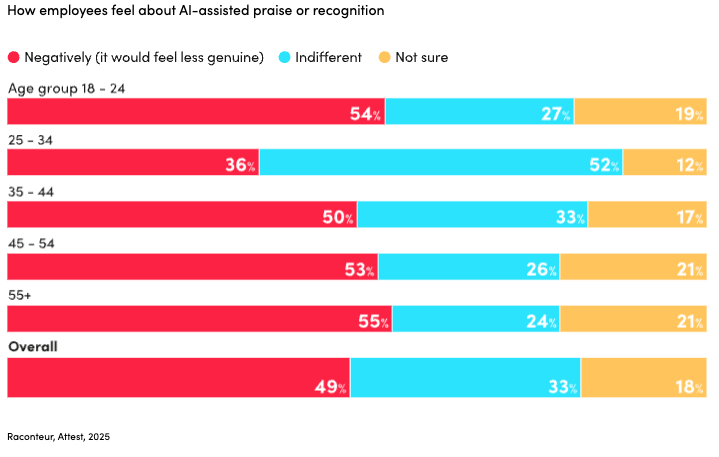
Key findings
- Trust, deception and leadership credibility
- 43% feel deceived when senior leaders rely on AI-generated communications
- 25% view AI-generated leadership communications positively
- 33% say AI-generated communication erodes leadership credibility
- 13% say it enhances leadership credibility
- 43% say the impact on credibility depends on leaders being transparent
What this shows: Perceived deception and credibility loss outweigh perceived benefits, with transparency acting as a conditional moderating factor rather than a guarantee of trust.
- AI in feedback, recognition and day-to-day management
- 28% would fully trust a manager if AI contributed to feedback
- 30% say AI-assisted feedback would damage trust
- 49% say AI-assisted recognition or praise lacks authenticity
- 55% of the oldest generation are sceptical of AI-assisted praise
- 54% of the youngest generation are sceptical of AI-assisted praise
What this shows: AI use in interpersonal management moments is highly fragile, with mistrust outweighing trust and scepticism strongest at both generational extremes.
- Decision-making, boundaries and disclosure
- 60% are uncomfortable with AI determining promotions or layoffs
- 91% want either strict limits or clear guidelines on AI use in employee interactions
- 43% want strict limits
- 48% want clear guidelines
- 62% want full disclosure of AI use at all times
- 23% want disclosure when AI use affects them
- 4% are comfortable with no disclosure
What this shows: Employees are not rejecting AI outright, but they are demanding governance, limits and transparency — especially where outcomes affect careers.
- Leadership capabilities AI cannot replace
- 55% say empathy and emotional intelligence cannot be replaced by AI
- 35% cite purpose and social awareness
- 30% cite vision and ambition
What this shows: Employees clearly differentiate between analytical support (where AI may help) and leadership qualities they expect to remain human.
What act on
The research shows a clear trust gap emerging as senior leaders increasingly use AI in communication and people management. Perceptions are already skewed negative: 43% of UK workers feel deceived by AI-generated leadership messages, while only 25% view them positively. A third believe AI erodes leadership credibility, compared with just 13% who think it enhances it. Transparency helps but does not solve the problem, with 43% saying credibility depends on leaders being open about AI use.
The risks are highest in day-to-day management and feedback. Only 28% of employees would fully trust AI-assisted feedback, while 30% say it would actively damage trust. Nearly half believe AI-assisted praise lacks authenticity, with scepticism strongest among the youngest and oldest workers. These findings suggest that interpersonal moments remain highly sensitive and poorly suited to automation.
Employees are also drawing firm boundaries around AI’s role in decision-making. Sixty per cent are uncomfortable with AI influencing promotions or layoffs, and 91% want strict limits or clear guidelines on AI use in employee interactions. Transparency is non-negotiable, with 62% demanding full disclosure at all times. Crucially, employees continue to value leadership traits AI cannot replace, particularly empathy, emotional intelligence, purpose and vision. Organisations should use AI to support analysis and preparation, while investing more deliberately in human leadership capability.
Read the research https://www.raconteur.net/talent-culture/ai-is-eroding-leadership-credibility