Research digested: Accountable Acceleration: Gen AI Fast-Tracks Into the Enterprise, Wharton Business School
About this research
This research, which surveyed eight hundred people across organisations in the US, is from 2025 but it provides some useful insights into AI adoption.
Key findings
Gen AI is now embedded in daily work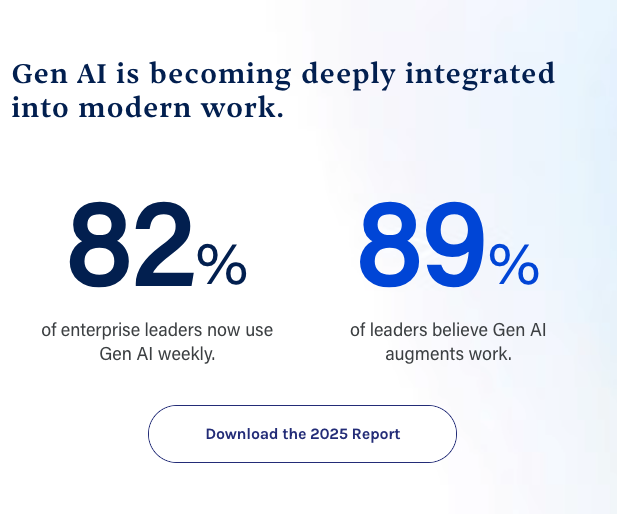
46% of leaders use gen AI daily and 80%+ use it at least weekly. It is mostly used for data analysis (73%), summarisation (70%) and document editing (68%). Use has shifted from experimentation to routine workflow integration.
Familiarity and expertise are rising
77% report being at least somewhat familiar with gen AI, with 32% identifying as experts. IT teams’ familiarity stands at 94%, with sharp gains in operations (+24% vs 2024) and legal (+17% vs 2024). However, depth remains uneven across functions.
Sector and seniority gaps remain
The tech, telecom, banking and finance and professional Services sectors are leading the way while sectors including retail and manufacturing are using AI tools less. 56% of leaders say adoption is “much quicker,” compared with 28% of mid-managers.
AI agents and ROI measurement are scaling
58% report organisational use of AI agents, primarily for automation and workflow efficiency. 72% formally track structured ROI metrics and 74% report positive ROI, although 34% of $2bn+ firms say outcomes are still unclear.
What to act on
The authors argue that Gen AI has moved from experimentation to accountability. With 72% formally tracking ROb, organisations must link Gen AI investment to measurable business outcomes such as profitability and workforce productivity.
They also emphasise embedding Gen AI into everyday workflows. Adoption is strongest in practical, repeatable tasks like data analysis (73%), summarisation (70%), and editing/writing (68%). The shift is from pilots to workflow integration, with around 30% of tech budgets now allocated to internal R&D to build customised solutions.
Finally, the authors say constraint around AI is organisational, not technical. That means alignment, training, governance, and trust are critical to prevent widening gaps between leading and lagging firms.
Read the report: https://knowledge.wharton.upenn.edu/special-report/2025-ai-adoption-report/