Research digested: Workmonitor 2026: The Great Workforce Adaptation, Randstad
About this research
Randstad’s Workmonitor 2026: The Great Workforce Adaptation surveyed 27,062 workers and 1,225 employers across Europe, Asia-Pacific and the Americas. The research was carried out in October 2025.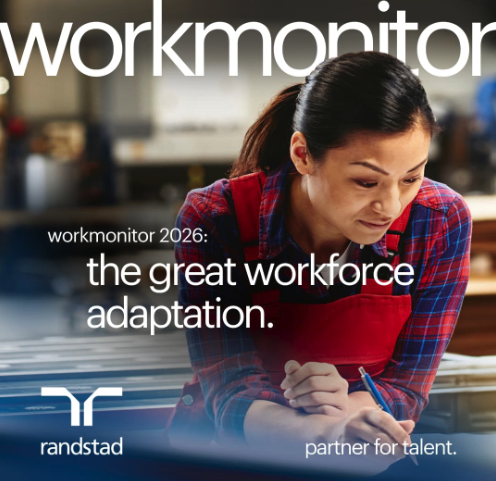
Key findings
A widening confidence gap between employers and talent
- 95% of employers expect business growth next year, compared with 51% of talent
This gap signals structural misalignment: growth optimism sits overwhelmingly with leadership, while half the workforce remains unconvinced.
Economic pressure is reshaping how people work
- 40% of talent have taken on a second job, and 36% have increased or plan to increase working hours
Rising living costs are pushing workers toward longer hours and multiple income streams, rather than job mobility.
AI is embedded but trust in its impact is uneven
- 63% of employers invested in AI in the past 12 months
- 62% of talent say AI has improved their productivity, and 63% say it makes their job easier
- Yet 47% of office workers believe AI benefits companies more than employees, and 21% of talent expect AI to have no impact on their work
AI adoption is accelerating, but there is a perception gap between AI aspiration and reality.
Don’t underestimate the role of managers
- 72% of talent say they have a strong relationship with their manager, up 8 points year-on-year
- 63% feel more connected to their manager than to the company overall
While trust in senior leadership has dipped, the manager-employee bond has strengthened and now underpins retention and reassurance.
Collaboration – especially across generations – boosts productivity
- 78% of talent say they are more productive when collaborating
- 95% of employers say multigenerational teams improve productivity
- But, 81% of employers say remote or hybrid work has made collaboration harder
Traditional career ladders are losing relevance
- 72% of employers say linear career paths are outdated
- 38% of talent explicitly say they do not want a linear career
Workers are increasingly favouring portfolio careers and varied experiences over long-term tenure.
Pay attracts, work-life balance retains
- 81% of talent say pay is the top factor when looking for a new job
- 46% cite work-life balance as the main reason for staying, ahead of pay and job security (both 23%)
Retention hinges more on balance and autonomy than compensation alone.
The autonomy reality gap
- 72% of employers believe autonomy boosts engagement and retention, but 81% do not allow workers to set their own schedules
There is a clear gap between employer beliefs and everyday practice.
What to act on
Workers want more autonomy, opportunities to collaborate and to develop the AI skills they need to succeed.
- Move beyond limited flexibility (where/when) toward greater autonomy in how work is done.
- Redesign roles and workflows so people have more control over schedules, priorities and outputs – while keeping accountability for results.
Invest in team-based and cross-generational collaboration rather than assuming it happens naturally in hybrid settings.
Provide AI skills development and help people apply AI to their actual tasks.
Read the report https://workforceinsights.randstad.com/download-workmonitor-2026